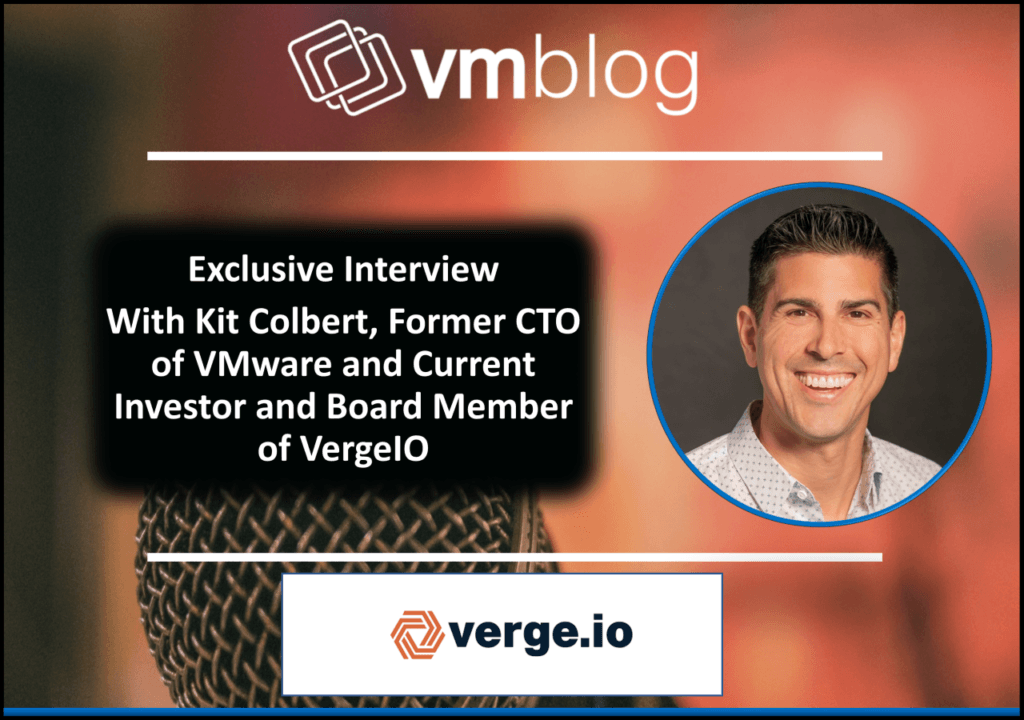
A VMblog Q&A with Kit Colbert, Former CTO of VMware and new Member of the VergeIO Board of Directors
When the architect of VMware’s multi-cloud strategy joins the board of a company displacing VMware, the announcement carries a particular weight. Kit Colbert spent two decades inside VMware, joining in 2003 as the technical lead behind vMotion, going on to run the Cloud-Native Apps and Cloud Platform business units, and rising to Chief Technology Officer in 2021. He led 2,400 engineers and set the technical direction of the platform through the Cross-Cloud Services and Aria era, until Broadcom’s 2023 acquisition.
This week he made a personal investment in VergeIO, the company behind VergeOS, and joined the Board of Directors. VMblog sat down with Kit to talk about what he sees in the architecture, why now, and what his read is on the next decade of private infrastructure.
VMblog: Kit, you spent twenty years inside VMware and led the technical direction of the company until Broadcom acquired it. Joining the board of a company displacing VMware is not a small move. What drew you to VergeIO?
Kit Colbert: The short answer is the architecture. The longer answer goes back to how the VMware stack came together over two decades. When we built the original compute virtualization, we did not know about storage virtualization yet, or network virtualization, or the management plane that would eventually sit over all of it. We built some of those layers ourselves. We acquired others. We figured it out as we went. The result was a stack that grew organically, layer by layer, vendor by vendor, with the seams that come from that kind of evolution.
What VergeIO has done is build the platform right from the ground up. They have the benefit of hindsight that the rest of us did not have when we started. They know what the architecture should look like because the last twenty years showed everyone what works and what does not. The categorical mistake the industry made along the way was treating integration as a packaging problem rather than an architectural one.
When you ship a hypervisor, a storage controller, a software-defined network, and a management plane as separate products from separate teams or separate vendors, you do not get an integrated platform. You get a stack with a unified bill. Every layer carries its own license, its own update cadence, and its own compatibility matrix. Operators feel that complexity every day.
VergeOS is the first private cloud product I have looked at where the integration is in the code rather than in the packaging. Virtualization, storage, networking, and tenancy run as native functions of one operating system, built from a single codebase. That is a different architectural starting point. It produces a different operational outcome.
VMblog: That contrast, integration in the code rather than in the packaging, is interesting. How do you describe the difference to people who hear “integrated platform” and assume they have already seen the movie?
Kit: It is a fair skepticism. The industry has used “integrated” so loosely that the word has lost a lot of meaning. My read is that most products marketed as integrated platforms are actually three or four products with a common management UI on top. That is not nothing. A unified GUI does reduce some operational friction. It does not change the underlying fact that you are still licensing, patching, and supporting separate software products underneath.
The test I use is simple. Ask whether the storage and the networking know about each other in the code, or whether they communicate through a management layer that has to translate. Ask whether snapshots are a function of the operating system or a feature of a separate product called from an API. Ask whether tenant isolation is a primitive of the platform or a configuration of a wrapper.
VergeOS passes those tests in a way I have not seen in this category. The architecture was designed to be one thing from the start, and that shows up in the operational simplicity that customers describe.
The Software Defined Data Center idea that the industry has used for years was meant to describe exactly this kind of system. A unified environment in which compute, storage, networking, and management work as one thing. What VergeIO has built is, in many ways, the version of SDDC the industry was originally aiming at.
VMblog: The press release framed the announcement around “a VMware exit today and the container and AI workloads that come next.” That second part is interesting. How does this architecture position the platform for AI workloads?
Kit: Modern workloads are getting more heterogeneous, not less. A typical AI inference workload involves containerized model servers, GPU passthrough, vector databases that look more like storage primitives than applications, networking that needs to handle east-west traffic at high concurrency, and tenant boundaries that have to hold under multi-team usage.
Agentic AI takes that picture further. The GPU runs the inference, but the CPU runs the coordination, the storage paths, and the orchestration that strings the agents together. You need both classes of compute working as first-class citizens on the same platform, not one bolted onto the other. That pattern is going to get more common, not less.
If your underlying platform is a hypervisor with bolt-on products, you are integrating four or five vendor stacks to support that workload. The seams show up under load. If your underlying platform is built as one system with virtualization, storage, networking, and tenancy as native functions, the same primitives that ran your traditional VMs are running your container fleet and your AI inference pods. You add GPU and AI-specific capabilities on top of the same architecture. You do not start over.
That is what I mean when I say VergeOS is built for a VMware exit today and the workloads that come next. It is not two different platforms with a common brand. It is one platform that runs both eras. Customers who pick the right architecture now are setting themselves up for the next decade, not just the next renewal cycle.
VMblog: What customer story convinced you the architecture works in production, not just in theory?
Kit: Topgolf is the one that stands out. They are running VergeOS at production scale across more than 100 venues, plus offices and data centers. They replaced VMware and Rubrik, and PowerEdge replaced VxRail. That kind of three-product consolidation onto one platform is the operational outcome you would expect from a true codebase integration, and they got it.
What surprised me when I spent time with the Topgolf team was the excitement. They are not just running VergeOS at scale, they are visibly fired up about what the platform lets them do operationally. That kind of customer energy reminded me of the early days of VMware, when customers would walk you through how the product had changed their day-to-day before you even asked. When the customer is doing the selling for you, something important is happening underneath.
What I look for in a customer story is the operational shape, not the logo. Topgolf has the operational shape of a customer running a unified platform. One team manages the estate. The compatibility matrix that they used to have to track across VMware, VxRail, and Rubrik disappeared into one operating system. Their team can focus on the business of running venues rather than the operational tax of maintaining four products in lockstep.
That is the architectural test I needed to see passed before I joined the board. Topgolf passed it.
VMblog: VergeIO talks about up to 70% reduction in combined capex and opex. Is that the right number to focus on, or is the architectural story more important than the economics?
Kit: The economics are downstream of the architecture, not upstream. The 70% number is real, and it shows up because the architecture eliminates cost categories at every layer, not because someone chose to discount aggressively.
Think about where the cost lives in a traditional virtualization stack. You pay for the hypervisor license, the storage controller license, the SDN license, and the management plane license. You pay for the teams that integrate them. You pay for the hardware refresh cycle that each layer demands on its own timeline. You pay for the consultants who close the gaps between layers. When you replace four product lines with one operating system, every one of those cost categories collapses or disappears.
Customers should care about both. The architectural story is why the economics are sustainable. The economics are why the architectural story has a budget to land in.
VMblog: The Broadcom acquisition of VMware has changed the conversation around VMware renewals significantly. What is your honest read of the position enterprises find themselves in right now?
Kit: I have a lot of friends and former colleagues at Broadcom and on the VMware side of the business. They are good engineers doing good work. I want to be careful to separate the technical work the team is doing from the commercial dynamics that customers are facing.
That said, the commercial reality is what it is. Customers face a choice. They can pay a renewal under terms that have changed materially from what they signed up for. They can migrate sideways to another virtualization vendor, which usually means trading one stack for another stack and discovering the same architectural ceiling a year or two later. Or they can move to a different category and exit the stack model entirely.
My read is that the third option is the one that actually solves the underlying problem. It is also the one most enterprises have not considered, because the category is new to them. Part of why I joined the VergeIO board is to help enterprise IT leaders see that the third path exists and that it is real.
VMblog: What do you plan to focus on as a board member? Where do you think you add the most value to VergeIO?
Kit: Two things. The first is technical strategy. I have spent twenty years thinking about how to build private cloud platforms at scale, and the questions VergeIO will face as it grows are familiar to me. How do you extend a tightly integrated codebase as the workload mix evolves? How do you maintain operational simplicity while adding capability? How do you support the next wave of hardware without fragmenting the platform? Those are decisions where the lessons I learned from running 2,400 engineers at VMware translate directly.
The second is enterprise credibility. There is a population of enterprise IT leaders who will look at a platform displacing VMware and want to understand whether the architecture is real or whether they are buying into marketing hype. I can speak to that question honestly because I have been on the other side of it. The architecture is real. The platform is production grade. My job on the board is to make sure that signal reaches the people who need to hear it.
VMblog: If you were running enterprise infrastructure today and facing your VMware renewal, what would you actually do?
Kit: I would not renew on autopilot. The autopilot decision is what gets you a worse contract at higher cost on the same architecture you were already running. The autopilot decision is also what every vendor in this space is counting on.
I would take the renewal moment as the architecture decision it actually is. I would run a real evaluation of what VergeOS does in a production environment. I would let my own operations team see what one platform versus four products feels like for them. I would let my CFO see what the total cost picture looks like when license layers collapse. And then I would make a decision based on what the next decade of workloads looks like in my organization, not what the last decade looked like.
That is what I would do. That is what the customers I have spoken to are doing.
VMblog: Closing question. When you look ahead at the next decade of private infrastructure, what do you think the industry will look like?
Kit: I think the era of the stack is over. The next decade of private infrastructure belongs to platforms designed as one thing from the code level up. The economic pressure on enterprise IT is too high, the workload mix is too heterogeneous, and the operational tax of running four products in lockstep is no longer sustainable at scale.
The companies that adapt to that reality will compete on real architectural value. The companies that try to repackage the stack model with a new GUI will lose. The architecture is the point.
I joined the VergeIO board because I want to be on the right side of that change. The architecture is correct. The product is shipping. The customers are validating it at scale. That is enough to bet on.
##
Editorial note: Kit Colbert was Chief Technology Officer of VMware until Broadcom’s 2023 acquisition of the company. He invested in VergeIO and joined the Board of Directors on June 2, 2026. The “Beyond the Hypervisor Swap” webinar with Kit and VergeIO Founder and CTO Greg Campbell aired Thursday, June 11, 2026. The session is now available on demand at https://www.verge.io/beyond-the-hypervisor-swap-vergeos-2026-architecture-parent/registration-beyond-the-hypervisor-swap-vio/.