There’s a moment in most vendor briefings where you can feel the marketing department’s fingerprints all over the slides. The ExaGrid session at the 68th IT Press Tour in Boston wasn’t one of them. Bill Andrews, the company’s CEO, opened with a joke about his Boston accent, took a couple of detours into Spotify and electric companies, and somewhere in the middle laid out one of the clearest pictures of the backup storage market you’ll hear all year.
I’ve covered this corner of the data center for a long time, and what struck me wasn’t a single feature. It was the consistency. ExaGrid does one thing, and Andrews spent two-plus hours explaining why that narrow focus is the whole point. Let me walk you through what mattered for the people who actually run this stuff.
The Setup: One Product, One Market, No Hiding
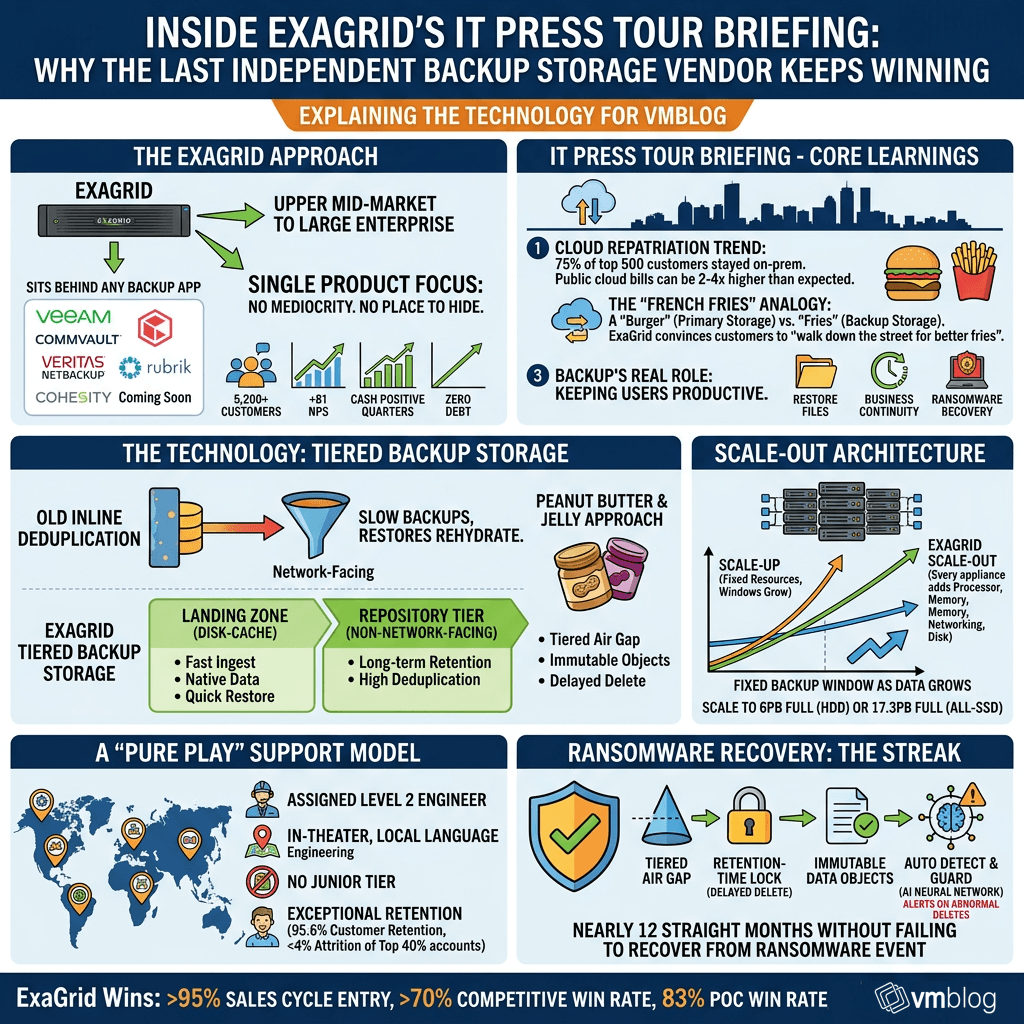
ExaGrid sells backup storage. That’s it. Not backup software, not primary storage, not archive. They sit behind whatever backup application you already run, whether that’s Veeam, Commvault, NetBackup, Rubrik, and soon Cohesity, and they store the data those applications produce.
Andrews made the stakes of that focus plain. When you only have one product, you don’t get to be mediocre at it. “If we don’t do this right because we don’t have one thing right, we’re in trouble,” he said. “There’s no place for us to hide.”
A few numbers from the briefing that frame the company:
- Over 5,200 active installed customers across 108 countries, with appliances certified in 132.
- An +81 Net Promoter Score, which on a scale that runs from minus 100 to plus 100 is pretty darn impressive.
- 22 consecutive cash-positive quarters, zero debt, and the last outside money raised was a $3 million round back in January 2013.
That last point deserves a pause. This is a private company that hasn’t needed investor cash in over a decade, runs P&L and EBITDA positive every quarter, and does half its business outside the United States. Andrews mentioned a board member half-joking that the company was sitting on so much cash it looked like a hedge fund. You don’t hear that from most storage vendors.
Who They Sell To, and Who They Walk Away From
Here’s the thing about ExaGrid’s target customer: they’re picky about it, and they say so out loud. The company chases upper mid-market through large enterprise data centers, customers with 50TB to multiple petabytes of data to back up, keeping four or more copies of retention, with a second site to replicate to.
What they don’t chase is just as telling. No SMB. No data that lives in the public cloud. Andrews was blunt that 75% of new customer bookings each quarter come from deals over $100K, with an average selling price around $280,000. They expect to close roughly five million-dollar deals in the quarter he was describing.
The customer support model is where the focus shows up in a way customers actually feel. ExaGrid assigns each account a senior Level 2 engineer, in-theater, speaking the local language, no junior tier, no calling pool. The same person handles your account every time. Andrews said that in the last decade, only about two support reps out of 60+ have left for reasons other than retirement. When your support people stay, your customers tend to stay too.
The Market Reality Check: The Cloud Didn’t Eat the Data Center
This was the part of the briefing that should land with VMblog readers, because it cuts against a story we’ve all heard a thousand times. Andrews doesn’t buy the “everyone’s moving to the cloud” narrative, and he has the customer conversations to back it up.
His analogy was a household one. You get internet from one company, electricity from another, music from Apple or Spotify, water from the town. Companies do the same. They run some workloads themselves, push DevOps bursts into a public cloud, hand CRM to Salesforce, and keep their core data centers right where they are. Goldman Sachs, in his words, is not handing its data center to anyone.
A statistic he shared makes the point hard to argue with: of ExaGrid’s top 500 customers over the last ten years, exactly three left because they moved data to a public cloud. Three. And he’s now seeing repatriation, customers pulling data back on-premises because the cloud bills, with all the read, delete, purge, and egress charges, came in at two to four times what the advertised per-terabyte rate suggested.
The reason this matters for backup storage is simple. It’s almost impossible (who has the bandwidth to do it?) to back up across the wide area network inside a six or seven hour window. So wherever the primary storage lives, the backup storage has to live too. On-premises primary data means on-premises backup. That’s the foundation ExaGrid’s whole business rests on.
Why Backup Still Comes Down to Keeping People Working
Andrews framed backup around a single idea: the job of IT is to keep users productive, because employees are the biggest cost in almost any company. Backup serves that goal in three ways, and it’s worth listing them because they map directly to how ExaGrid built its product.
- Restoring deleted, overwritten, or corrupted files so a user doesn’t lose a day of work.
- Keeping the business running through a disaster, an earthquake, a flood, a fire, with a second copy somewhere else.
- Recovering from a ransomware attack, where the threat actor has copied your data, encrypted it, and deleted your backups.
He walked through how a ransomware attack actually unfolds. A phishing email, a click, code that quietly watches password usage, scanners switched off during off-hours, data copied and encrypted, then a double-extortion ransom note. The backups are often deleted first. If your only protection is network-facing storage, the attacker can reach it.
That threat model is the reason backup storage has to do more than sit on the network and hold bits.
The Four-Horse Race in Backup Software
One of the more candid segments was Andrews’s read on the backup application market. ExaGrid supports most of the companies you’ve heard of, so he has no dog in the fight, which makes his assessment useful. When customers look to switch, he says, 99.9% of the time the names on the table are Veeam, Commvault, Rubrik, and Cohesity. Everything else is a rare mention.
By revenue, without giving away any numbers, he framed it as roughly Veeam leading the charge, and then Cohesity (with NetBackup), Rubrik, and Commvault each trailing roughly 25%+ behind.
His bigger argument was about why a new backup software startup has almost no shot today. The market shifted once, when virtualization arrived and the old guard (NetBackup, Commvault, NetWorker, TSM, all coded decades ago) couldn’t keep up. Veeam, Rubrik, and Cohesity rushed through that opening. Now those products are modern and well-funded, and there’s no hole to run through until they get old again, which he puts a decade or two out.
The Cohesity acquisition of NetBackup did create one interesting ripple. A NetBackup base that was locked down for years is now lifting its head and looking around, which benefits Veeam, Commvault, and Rubrik, and gives ExaGrid more “switching the storage” conversations to walk into.
The Heart of It: Tiered Backup Storage
So what does ExaGrid actually do differently? Andrews framed it as fixing two broken approaches.
You can put primary storage (Dell, HPE, NetApp, Hitachi) behind your backup app. It’s fast for backups and restores because data lands and stays in native format, but it does no deduplication, so retention gets expensive fast, and it’s network-facing.
Or you can use an inline deduplication appliance (Dell Data Domain, HPE StoreOnce, NetBackup appliances). It saves storage through dedupe, but inline dedupe runs at roughly a third the speed of disk, restores require rehydrating every request, and the scale-up architecture means the backup window expands as data grows. It’s also network-facing.
ExaGrid’s answer borrows from the old tape-staging playbook. The company combines a disk-cache Landing Zone, where backups land fast and the most recent copy sits ready in native format for quick restores, with a non-network-facing Repository Tier that holds all the deduplicated long-term retention. Peanut butter and jelly, as Andrews put it.
A few things make this work in practice:
- A scale-out architecture where every appliance brings its own processor, memory, networking, and disk, so the backup window stays fixed in length whether you’re at 100TB or five petabytes.
- Deep backup integrations, the Veeam Data Mover (30% faster ingest), Commvault Spill and Fill, nine NetBackup certified integrations, plus further deduplication of data that Veeam, Commvault, or Rubrik already deduplicated.
- A claimed ability to scale to a 6PB full backup in a single HDD system, and 17.3PB in a single all-SSD system, well past Dell’s largest Data Domain.
The competitive numbers Andrews cited are worth knowing. ExaGrid gets into the sales cycle over 95% of the time when there’s a real project, wins over 70% competitively (74% across the last four quarters), and wins 83% of the time when a customer runs a head-to-head proof of concept. Retention sits at 95.6%, and in the top 40% of accounts attrition is just 2% a year.
The Rubrik Angle and the Cloud Repatriation Play
One section that deserves attention from anyone running Rubrik: the company has stepped out of the storage business entirely, telling customers to keep a couple weeks on the Rubrik brick and send the rest wherever they want. Many send retention to AWS or Azure, and then, about 10 to 12 months later, stop, because the cloud bill is eating them alive.
That’s ExaGrid’s window. The company can uncompress Rubrik’s archived data and further deduplicate it, taking a roughly 3:1 reduction up to somewhere between 9:1 and 30:1 depending on retention. They wait out the cloud honeymoon, then show up with the on-premise math when the customer already believes the bill. Their “instant archive” approach also keeps the most recent two weeks plus all retention on the ExaGrid as an added line of defense.
Ransomware Recovery: The Twelve-Month Streak
The security story is where ExaGrid has clearly put recent engineering effort, and it’s built on that non-network-facing Repository Tier. A threat actor can issue a command to delete everything, and the repository, sitting behind a tiered air gap that only ExaGrid’s own software can reach, isn’t touched.
On top of that sits a delayed-delete policy (typically around 10 days, costing only about 10% more repository space) and immutable data objects. The newest piece is Auto Detect & Guard, an AI neural network built into the product that learns a customer’s normal delete patterns. When deletes look abnormal, it alerts, extends the delayed-delete policy indefinitely, and waits for a human on the IT or security team to clear it.
Andrews said the company is approaching twelve straight months without a single customer failing to recover from a ransomware event, with a formal announcement likely in July. He told one story of a public company whose cyber-insurance consultant said recovery would take 30 days; ExaGrid had them running in three, and earned a thank-you email and another million-dollar order.
The French Fries Argument
I’ll leave you with the analogy that stuck with me most, from a former Commvault executive now at NetApp who told Andrews he was “breaking all the rules.” People buy their fries where they buy their burger, the executive said. You order both at the same window. The burger is the primary storage; the fries are the backup storage. By default, whoever sells you the primary storage sells you the backup storage too.
ExaGrid’s entire business is convincing customers to walk down the street for the fries. The fact that they hold maybe 2 to 3% market share against Dell, HPE, and NetApp isn’t a weakness in Andrews’s telling; it’s runway. The big players are chasing $40 billion and $160 billion storage businesses and have little reason to invest in a market this small.
That’s the takeaway for VMblog readers. ExaGrid isn’t trying to be everything. It backs up your data, keeps your people productive, gets you back on your feet after an attack, and does it without the cloud-bill surprises or the forklift upgrades. In a market full of platform pitches, there’s something refreshing about a vendor that knows exactly what it is.
Coming Up
For those tracking the roadmap, ExaGrid’s end-of-June release adds NFS over-the-wire encryption, share quotas for MSPs (with billing-usage alerts when a customer exceeds contracted terabytes), and the long-awaited Cohesity support, with more specifics promised in July.
If you run backups at any scale and you’ve never tested ExaGrid head-to-head, that 83% POC win rate is either marketing or a standing challenge. Based on this briefing, Andrews would tell you it’s the latter.
##