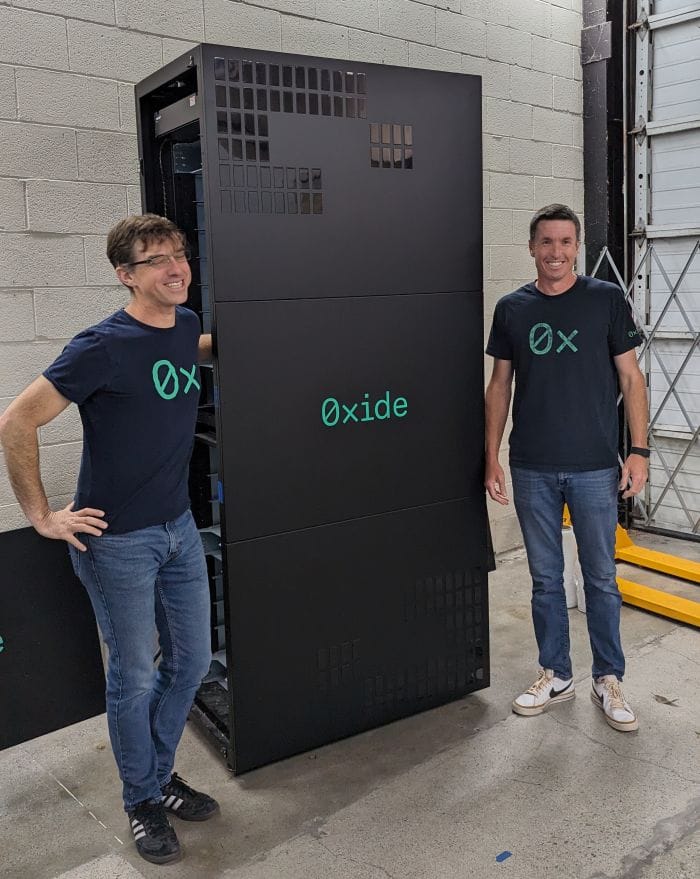
While at the 56th edition of the IT Press Tour event in California, VMblog had the opportunity to learn about Oxide Computer, a company aiming to revolutionize the world of private data centers. We met with Steve Tuck, co-founder and CEO of Oxide Computer, and Bryan Cantrill, co-founder and CTO, who outlined their innovative approach.
Oxide Computer is on a mission to revolutionize the private data center industry by offering a unique solution that combines the efficiency and scalability of cloud computing with the security and control of on-premises infrastructure.
The Traditional Data Center Landscape
According to Oxide Computer, traditional on-premises data centers face a fragmented ecosystem rife with integration challenges, performance barriers, security vulnerabilities, and a lack of developer-friendliness. Setting up a new infrastructure can take months, with product silos hampering efficiency and reliability. Proprietary software propagates security holes, while developers often find APIs treated as an afterthought.
The Vision: Bringing Cloud-like Efficiency to Private Data Centers
The company’s vision is to re-imagine the private data center as a cohesive, cloud-like system, combining hardware, software, and networking into a unified platform designed for maximum efficiency, security, and developer-friendliness.
Oxide Computer is taking a radically different approach, treating the entire data center as a unified “cloud computer.” Their solution centers around three key pillars:
- Rack-level Hardware Design – Rather than using traditional servers, Oxide has developed specialized rack-level hardware tailored for maximum integration and efficiency across the data center. This end-to-end design aims for 2x better efficiency compared to traditional setups. The hardware platform features a dynamic power management system, streamlined airflow design, and telemetry capabilities that provide full system visibility. By optimizing power delivery, cooling, and resource utilization, Oxide Computer can significantly reduce operational costs and environmental impact.
- Cloud Software Stack – Oxide emphasizes an open-source, fully programmable software approach with robust API support to empower developers. Oxide’s Virtual Private Cloud (VPC) service allows users to create, organize, and isolate project-specific networks across all their Oxide racks. This virtualized networking solution provides observability, self-service capabilities, and seamless integration with existing tools and processes.
- Unified Networking – Comprehensive networking capabilities are built-in, enabling self-service configuration and end-to-end observability of network paths to understand operational impacts. Users can configure full networking capabilities quickly and easily, either via API, CLI, or a user-friendly console.

Bringing Cloud Benefits On-Premises
By unifying compute, storage, networking, and services into an integrated “cloud computer” system, Oxide aims to bring many of the benefits of public cloud architectures into private data centers:
- On-Demand Provisioning: Oxide provides on-demand virtual machine provisioning combined with persistent block storage, enabling rapid compute and storage elasticity.
- Networking Virtualization: Their virtualized networking lets users create isolated environments per project and configure advanced capabilities via API.
- Observability: End-to-end telemetry gives visibility into what components exist and their performance impacts, akin to public cloud monitoring.
- Efficiency First: The rack-level hardware design, including an integrated DC bus bar, optimized fan/airflow control, and resource prioritization, maximize power efficiency.
- Integrated Security: Oxide’s secure software attestation, data encryption, auditability and patching reinforce protection against threats like supply chain attacks.
- Developer Empowerment: With APIs as first-class citizens, developers can leverage a self-service cloud-like environment using familiar processes and tools like Terraform.
The Promises of Doing More with Less
Ultimately, Oxide Computer aims to help organizations “do more with less” by providing an integrated data center architecture that condenses deployment timelines, improves resource efficiency, forecasting and eliminates wasteful overhead. Their bold re-imagining of treating an entire data center as a tightly integrated “cloud computer” promises the agility of public clouds with the control of an on-premises footprint.
As data centers continue to evolve, innovators like Oxide Computer are rethinking fundamental assumptions about how to architect more efficient, secure and developer-friendly infrastructure environments. The IT Press Tour provided VMblog with an inside look at their pioneering vision.