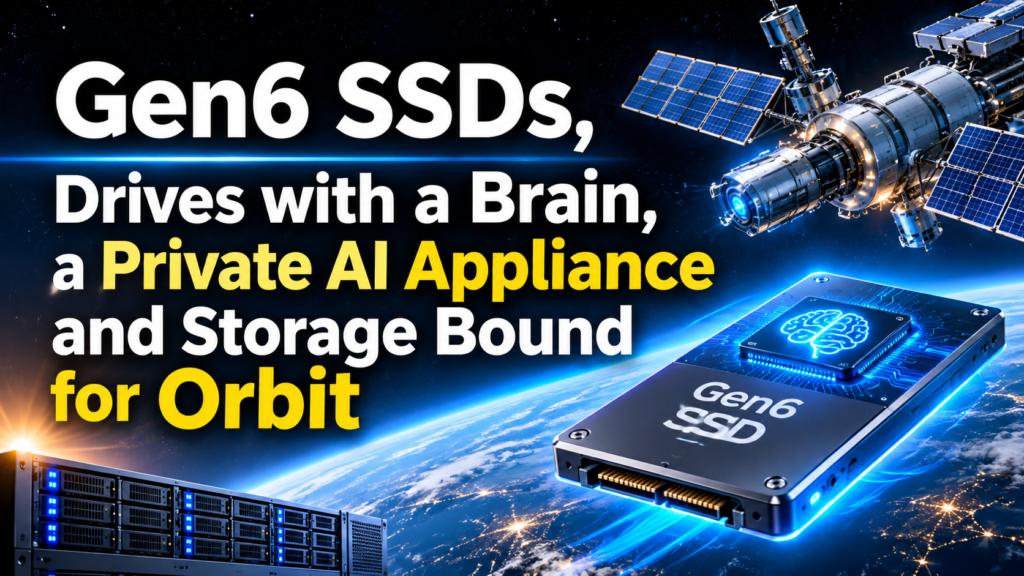
A little over a week ago, Phison walked into Supercomputing 2026 in Chicago with a number of announcements and a booth full of things most people don’t expect from a flash company. A PCIe Gen6 enterprise controller. An SSD that mixes two kinds of flash behind one controller. A drive with its own NPU that can run Linux. A turnkey, on-premises AI system for business intelligence. And a brand-new line of SSDs built for outer space.
I got an early look at all of it back in October, when the IT Press Tour sat down with Phison in Palo Alto. I covered what I could prior to the embargo breaking in part one of my article covering Phison’s record $3.4 billion first half, the Pascari enterprise brand and aiDAPTIV memory extension. This installment covers what the company shared with me back then that I couldn’t share until now.
The timing of the announcements tells you how Phison sees the next few years. Michael Wu, President and GM of Phison US, put it this way: “The next era of computing won’t be defined by processing power alone, but by how efficiently we can move, process and store the data that fuels it.”
Hold onto that sentence. Almost everything below is a different answer to it.
One Thread Through Five Announcements
If you only skim the headlines, these look like unrelated products. A space SSD has little to do with a BI appliance, right? Not quite, and Wu explained why during the briefing.
His argument goes like this. Storage has traditionally been where data sits. AI changes that, because a stored result can replace a computation. When an AI system saves its working memory (the KV cache) and reads it back later, it doesn’t have to work it out again. “Storage becomes the new compute,” Wu told us. “That’s the headline.”
He then did some napkin math that I won’t pretend is rigorous, but it makes the point. Stack up more AI users, people (and agents) using AI far more often, and a shift from text to images and video, and Wu landed on demand growing somewhere between 500 and 1,000 times. Storage, he noted, can’t even double in three years. So the work has to move to the edge, and the data has to move less.
Phison called this shift “Phison 3.0: from storage to complete AI solutions.” Keep that frame in mind. Gen6 moves data faster. Computational storage moves less of it. Mixed Media wastes fewer drive bays. The AI Data Platform packages the whole thing. Pascari Space takes it somewhere no data center has gone before.
PCIe Gen6: Twice the Lanes’ Worth of Speed
Let’s start with the one that will look familiar to anyone who tracks SSD roadmaps. Phison announced its X3 (PS5303) enterprise SSD controller for PCIe Gen6, and the numbers are what you’d hope for:
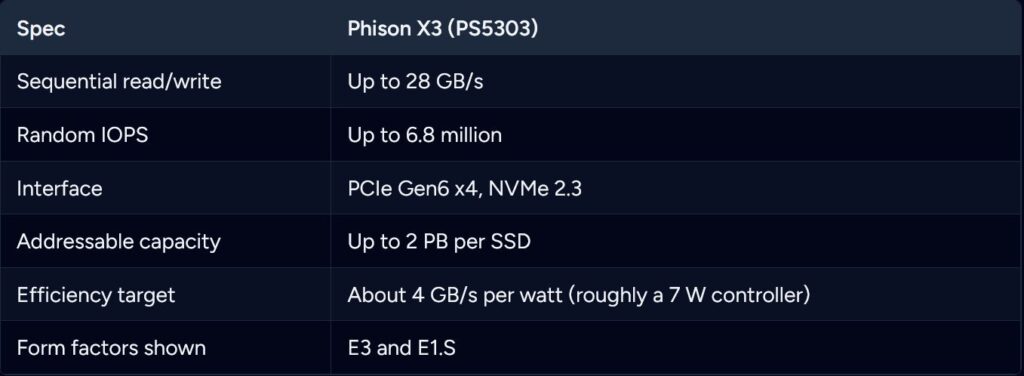
Sebastien Jean, Phison’s CTO for North America, brought samples to the briefing and passed them around the room: a working Gen6 drive, the silver X3 chip itself, and E1.S and E3.S variants, including one board that swaps tantalum capacitors for a cluster of slim electrolytic ones so everything fits inside a narrow case. It’s the kind of thing you remember from a briefing.
Jean walked us through why Gen6 isn’t simply Gen5 with the dial turned up. The per-lane rate doubles from 32 to 64 GT/s, but Gen6 gets there by switching from two-level (NRZ) signaling to four-level PAM4. More levels in the same space means less margin for noise, so the real engineering fight is signal integrity. That is why Phison is building the whole chain at once: SSD controllers, redrivers and retimers, with firmware tuned across all of them. The company also said its PS7161 is the first PCIe 6.0 redriver on the PCI-SIG Integrators List, which backs up its claim that it can supply the pieces of the link from one place.
A few details from the room stuck with me.
Phison was straightforward about who needs Gen6. Hyperscalers and AI buyers, yes. Regular data deployments? Not a must-have yet. The demand comes from AI, and from a design pattern where four SSDs are paired with each GPU to saturate its PCIe lanes and hold checkpoints and scratch data. With Gen5 that’s about 14 GB/s per drive. With Gen6 it’s about double. Jean went a step further and said that once Gen7 arrives, at roughly 50 GB/s per SSD, flash starts to look like a DRAM-class bus in raw throughput.
On timing, engineering samples are available now with partners, and Jean pointed to early 2027 for general availability. Heather Davis, Phison’s Senior Director of Corporate and Product Marketing, added a useful caution during the session: what’s been announced is the readiness of the silicon. A Pascari product built on it hasn’t been announced yet.
Two more notes on strategy. Phison is already designing Gen7, since a controller takes two to two and a half years to build and the pipeline always has to hold the next one. And Jean was cool on CXL for SSDs, arguing that once you saturate the PCIe bus, CXL doesn’t bring much that plain PCIe doesn’t. Everyone may not agree, but I appreciated a CTO who’d say it out loud.
Mixed Media: Stop Spending Drive Bays on Cache
This was my favorite announcement of the day, mostly because the problem is so easy to picture.
Look inside a lot of high-end storage servers and you’ll find a small number of fast SLC drives (the industry calls them storage class memory, or SCM) acting as a landing zone for incoming writes. Data gets acknowledged quickly, then gets deduplicated or compressed, then lands on big, cheap QLC drives for the long haul. It works. But in a 24-bay chassis, every bay used for cache is a bay that holds zero user data, and user data is what the customer is paying for. There’s also a reliability problem: lose one of four cache drives and you’ve lost 25% of your fast tier.
Phison’s Mixed Media answer is to put both media in every drive. Each SSD carries pSLC dies and QLC dies behind one controller (the PS5302-X2) across 16 channels. Jean described it with a candy-aisle analogy that got a laugh and also explains it well. The SLC and QLC drives used to sit side by side on the shelf, like chocolate and peanut butter. “What if we smush them together?”
The clever part is how the split is done. Plenty of drives already use pseudo-SLC as a write cache, but they carve it out at the block level, so a long QLC program operation can block an SLC read. Phison partitions at the die level instead, so the two don’t fight. Only 1% to 4% of raw capacity goes to the fast tier, depending on configuration.
Against a typical setup, Mixed Media gets you more of both. The 1 SCM plus 23 QLC row does edge it on raw QLC, but you’d have a single, unprotected cache drive and a sixth of the fast tier. Nobody serious runs that way. Phison also says the cache scales as you add drives, and when a drive dies you lose 4% of the cache instead of 25%. A technician swapping a failed unit doesn’t need to check whether it’s a cache drive or a capacity drive. It’s just a drive.
Here’s what I think procurement teams will like most: two SKUs become one. Phison ships drives with endurance groups and namespaces preconfigured, and a software tool can convert a fresh-out-of-box QLC drive into a Mixed Media one, so a buyer can stock a single part for both kinds of systems. Jean said Phison sells a programmable variant to large customers for exactly that reason, with five or six configurations to choose from rather than endless options. (“We don’t want to be infinite,” Wu added.)
Software changes should be modest. In Linux, each drive shows up with two namespaces (so nvme0n1 and nvme0n2 instead of separate devices), and the host stack otherwise “barely notices.” Jean estimated a couple of weeks of work plus validation for a storage vendor to adapt, and said Phison is working with storage partners on that now.
The specs on the first product are worth noting:
- Interface: PCIe 5.0 x4 (single port) or x2 (dual port), NVMe 2.0d
- Form factors: E3.S and E3.L
- Capacities: from 11.52 TB QLC plus 600 GB SLC up to 115.2 TB QLC plus 1,200 GB SLC
- Endurance: SLC at 60 DWPD, QLC at 0.3 DWPD over five years
Mass production was slated for the November to December window, and Jean said the design will carry over to Gen6. As for competition, Jean said none has announced anything similar, and that the idea came from a large storage provider who asked Phison to merge the two tiers. The firmware work took a little under a year. He’d welcome Samsung, Kioxia and Micron building the same thing, since a lone supplier makes buyers nervous.
Computational Storage: A Small Server Inside the SSD
The idea behind computational storage is simple: stop hauling data to the compute and bring the compute to the data. Phison is putting an NPU, a CPU cluster and its own memory pool inside the SSD, so the drive can scan and filter its own contents and return answers instead of raw data. During SC26, the company said this can cut data movement by 10 to 100 times for suitable workloads.
The specs for Phison’s first computational SSD (CSD):
- 36,800 DMIPS of compute plus an NPU, about 40 TOPS per drive
- 64 GB of RAM at 130 GB/s
- Runs Linux, shows up as its own PCIe device
- Support for PyTorch, vLLM, OpenVINO and llama.cpp
Earlier attempts, he said, were right ideas arriving too early. Too little memory, too little bandwidth, and in the SmartSSD’s case an FPGA that limited who could write applications for it. Phison’s version has what he called a tipping point: every axis improves at once, and since it runs Linux and standard AI frameworks, a developer doesn’t need hardware-design skills. It “behaves like a small server rather than an accelerator.”
Why bother? Jean showed the bandwidth squeeze. SSD bandwidth roughly doubles every two years, compared with about 1.6x for DRAM and 1.4x for interconnects. Picture a server with 20 DDR channels at 50 GB/s each, so 1,000 GB/s. Now ask 24 Gen6 SSDs (672 GB/s), the CPU (772 GB/s) and a 100 GB/s NIC to share it. Demand tops 1,500 GB/s. The CPU’s memory bus has become the bottleneck.
Put the compute in the drive and the numbers flip. In a 24-bay computational storage array, Phison counts 672 GB/s of data scan, a 768 GB shared DDR pool, 3,120 GB/s of aggregate memory bandwidth and 960 TOPS, with zero host CPU involved. The host just sends control messages (“scan this chunk, fetch that”) instead of moving data.
Say you’re hunting for peaks in petabytes of wind tunnel or weather data. Traditionally, you’d pull everything across the network to the cluster, which can take a day. With a CSD you tell the drive what range of values matters, and it returns the matching blocks. That’s where the “10 to 100 times” figure comes from, and it’s a best case for the right workload, not a promise for everything.
The product is aimed at 2027 alongside Gen6. I’d treat this as the one to watch rather than the one to buy today.
Phison AI Data Platform: A Private AI Analyst in a Box
If Gen6 and computational storage are about hardware, the AI Data Platform (AIDP) is where Phison shows how far up the stack it wants to go. The first solution is GenBI, and it’s available now.
Rick Allen, Senior Product Marketing Lead for AI, explained the idea. Phison announced the broader platform at Computex in June. What launched at SC26 is its first application: a single-server, on-premises system for generative business intelligence. Employees ask questions about company data in plain English and get SQL-backed answers, charts and dashboards, with no waiting on an analyst’s report.
Phison delivers three layers as one product:
- Application: Wren AI’s GenBI software, with its governed context layer that grounds answers in approved business definitions and access policies
- Platform software: a resource orchestration layer built by Phison (Kubernetes-based) that runs the models, GPUs and application
- Hardware: an AI server with Pascari aiDAPTIV cache memory, in four- or eight-GPU configurations
On GPUs, Allen said Phison is NVIDIA-only for now, while staying neutral on Intel versus AMD CPUs. TrueNAS is the first enterprise storage partner, starting with an independent, on-premises backup and restore target for GenBI.
Why would anyone want this instead of calling a cloud API? Allen laid out three reasons, and they’re practical ones. Privacy: some customers aren’t allowed to send data to the cloud, or don’t want to. Control: “If you control it yourself on-prem, you control all versioning,” he said, so a model update from somebody else can’t break your work overnight. And cost: you own the server, so there’s no per-token bill that rises with every question asked.
The other pitch is time. Phison puts the do-it-yourself route at three to six months, picking hardware, models and software, then integrating and testing. Its target for AIDP is 14 days from hardware delivery to the first application live. It’s a target, not a guarantee, and every environment is different. But the idea of buying a solution instead of assembling one is the right instinct.
Phison also shared a lab result worth knowing about, with the usual caveat that it’s the vendor’s own test. Running the Wren AI agent, aiDAPTIV delivered twice the concurrent sessions on the same GPUs, with 3.7 times faster time to first token. That ties back to part one: the cache tier isn’t only for laptops.
On Wren AI itself, the company points to 50,000-plus users worldwide, a community growing about 5x a year, and the top GenBI project on GitHub with more than 17,000 stars. Those are Wren’s figures, as reported by Wren. Howard Chi, Wren AI’s co-founder and CEO, said the pairing lets organizations “scale AI-powered analytics while maintaining control over their data, models, and operations.”
Wu was clear that GenBI is a starting point. The 2027 plan adds multi-server scaling, AI servers alongside storage and cache servers, clustering, and more applications, including an agent layer for document intelligence, customer service and enterprise knowledge. The business logic, he said, is simple.
“Do people want to buy a server, or do they want to buy a solution?”
— Michael Wu, President and GM, Phison US
Wu said Phison wants to find domain-expert software vendors, for example in ERP for manufacturers, who can sit on top of the platform. He argued that big vendors are focused on the cloud and that nobody is stitching together the edge, validating models every week as new ones appear. Wu claimed even NVIDIA has told Phison it lacks a true edge play. That’s Wu’s account, not NVIDIA’s, but it explains why Phison’s systems partners in Taiwan are listening.
Pascari Space: Storage That Can’t Be Serviced
The closer, and the one that earned the biggest reaction, was Pascari Space. Part one touched on the orbital data center market. Now Phison has a product line for it.
Jean opened with a story about watching Star Wars in 1977 and deciding he’d be an X-wing pilot. Then he made the point of the session:
“Space is real. It’s not a fantasy. It’s not three years away like cold fusion.”
— Sebastien Jean, CTO North America, Phison
The case is reasonably straightforward. Terrestrial data centers are running up against power, water, carbon and land. In orbit, power is solar, cooling is radiative, and no water is involved. Launch costs have fallen enough that 167 orbital missions flew from a single provider in 2025, and an NVIDIA H100 is already operating in space. Jean put the launch’s footprint in context: about 485 tons of CO2 equivalent for a Falcon 9 flight, which maps to roughly six weeks of a 1 MW data center on Earth, or about ten hours of a 100 MW one.
Phison isn’t new to this. The company says it developed the first uSSD used on NASA’s Perseverance rover on Mars in 2020. A customized 8 TB M.2 SSD reached Technology Readiness Level 6 in 2022. In 2025, Pascari enterprise SSDs customized through IMAGIN+ flew on Lonestar Data Holdings’ commercial lunar payload and came through launch, cislunar transit and arrival, which is the first data center hardware on the Moon. That heritage is why Phison now claims TRL-9 status for Pascari.
Three Product Lines, Nine Tricks
Pascari Space comes in three lines:
- pSLC, TLC – DRAM-less, Built for Harshest positions, where survival beats performance
- pSLC, TLC – DRAM, General spacecraft systems and onboard compute
- TLC, QLC – DRAM, Bulk, high-capacity storage in orbit
Jean made a point I liked: Phison is not building a ten-million-dollar rad-hard drive on six-year-old technology. It adapts current Pascari enterprise platforms to space, so customers get modern NAND and controllers with firmware and validation tuned for the environment. Radiation, he said, is “an accelerant, not a new problem.” The failure modes are the ones Phison already fights on Earth (voltage shift, program and erase failures, bit flips). The rate is what changes, so the same algorithms just run more often.
The protection stack is thorough. pSLC operation for wider voltage margins (Phison cites up to 60x the endurance), LDPC error correction, SRAM interleaving that turns one uncorrectable three-bit error into three correctable single-bit ones, randomized RAID mapping across dies and planes, SmartECC, SmartRefresh and power-loss protection. Telemetry goes well beyond standard SMART, because nobody can physically reach these drives.
My favorite detail is the in-flight recovery. If a solar flare wipes everything, including the SSD’s own firmware, Linux-based tooling in a small shielded container can rebuild the drive in place. The data is gone, but the drive isn’t dead silicon. It comes back.
Everything is co-designed through IMAGIN+: mission discovery, radiation characterization (TID and SEE testing, including heavy-ion work, offered as a service), firmware tuning, then manufacturing with 48-hour burn-in and 100% outgoing test. Customers can even pay for lot testing and receive only the best drives from a larger batch. As Jean put it, it’s about “de-risking the mission,” which helps with approvals, funding and insurance.
A First Customer with a Launch Date
The anchor deal is with Lonestar Data Holdings. Phison will supply storage for StarVault-001, Lonestar’s first commercial orbital data center node, expected to launch in the first half of 2027. It will carry 488 TB of Pascari Space storage, giving roughly 370 TB of usable capacity in low Earth orbit.
Lonestar founder Chris Stott said the company is “building a secure, sovereign data infrastructure beyond Earth, independent of terrestrial risks,” and that Phison’s storage is one of the technologies going into the StarVault architecture.
One more point from Jean connects this back to computational storage. Downlinks from space are slow, so the more a satellite can process on board, the less it has to send home. A drive that can filter or analyze data in orbit is a natural fit. He added that drone and robot makers have shown interest in the same idea.
So, Why Should You Care?
Here’s where I land after sitting through all of it.
First, the announcements fit together better than most vendor roadmaps do. Gen6 moves bytes faster. Computational storage and aiDAPTIV make you move fewer of them. Mixed Media squeezes more value from every bay. AIDP and Pascari Space show Phison selling solutions and missions, not parts.
Second, the timelines vary a lot, and you should read them that way. GenBI and Pascari Space are available now. Mixed Media was slated for mass production around the turn of the year. Gen6 and computational storage are 2027 stories. Plenty of vendor-run numbers here (the 39x RAG result, the 2x sessions, the 10-100x data reduction) will need independent testing to hold up.
Third, the company is honest about trade-offs, which still isn’t common. Flash isn’t DRAM. Gen6 isn’t a must-have for everyone. Computational storage has a graveyard of earlier attempts. Jean and Allen said all of that out loud.
Phison spent 25 years being the name you didn’t see. After this year, that’s going to be harder to say. For my part, I’ll be watching whether a Pascari Gen6 product follows the silicon, and whether the computational storage ecosystem shows up on time.
##