After a week in Palo Alto with Clockwork, Cohesity, CTERA, DDN, Hammerspace, Phison, ScaleFlux and VergeIO, the same story kept surfacing from very different corners of the stack: the AI bill is real, the hardware is scarce, and the fix is mostly about not wasting what you already own.
Here’s a strange thing that happens on an IT Press Tour. You sit in a room with a network software startup at 9 a.m., a backup giant by lunch, and a flash controller company by mid-afternoon. On paper, they have almost nothing to say to each other. Then you get home, line up your notes, and realize all eight companies were describing a very similar problem from different angles.
At the 70th edition of the IT Press Tour in Palo Alto, I had the pleasure of meeting with Clockwork, Cohesity, CTERA, DDN, Hammerspace, Phison, ScaleFlux and VergeIO. One fixes broken network links under a live training job. One protects roughly 200 exabytes of backup data. One sells parallel storage to NVIDIA and Google. One makes the silicon inside SSDs, and one rebuilt the hypervisor from scratch and just hired a VMware veteran to run it.
Different layers, same worry. Everyone has bought, or is about to buy, a lot of expensive AI gear, and almost nobody is getting full value from it. GPUs sit idle waiting for data. Memory costs a fortune. Power is capped. Pilots stall before production. And the attackers, as Cohesity pointed out, are using AI too.
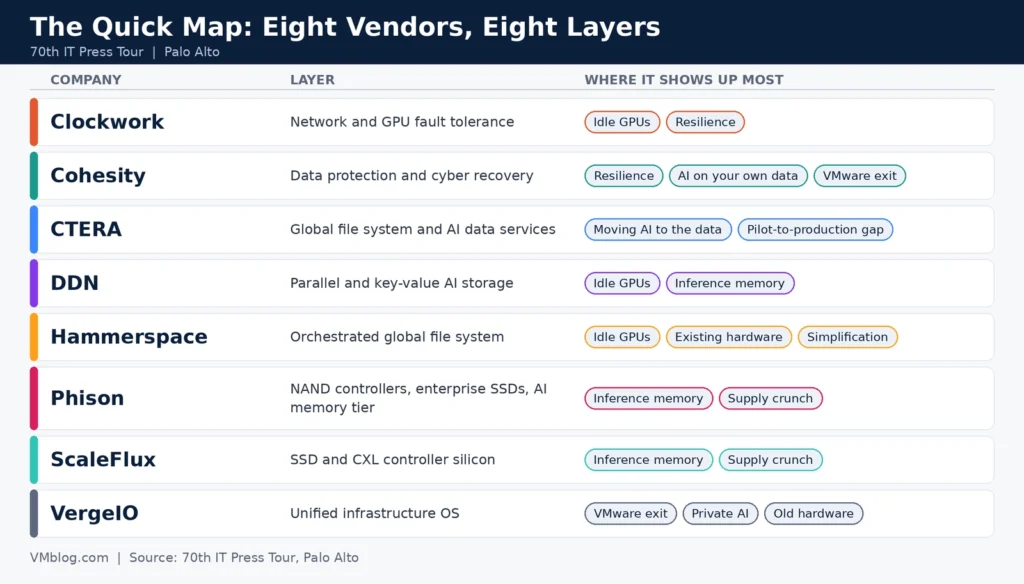
I pulled out seven themes that ran through the week. For each one, I’ll tell you where the vendors landed, what’s worth remembering, and where I think this is heading. Here’s the quick map before we get into it.
Theme One: The Idle GPU Is the New Villain
If you want one picture to hold on to from that week during the IT Press Tour, it’s Clockwork’s champagne tower. Picture 1,024 GPUs, roughly $150 million of equipment, stacked like glasses. Touch any single one and the whole thing comes down. Every vendor in this section is trying to keep that tower standing, just from a different floor of the building.
The numbers behind the worry are not abstract. Clockwork cited published research showing a mean time to failure of about 7.9 hours for 1,024-GPU jobs at Meta, and an unexpected interruption roughly every three hours during Llama 3 training. When you pay for GPUs by the hour, a stall doesn’t just waste time. It wastes the most expensive time in your building.
Clockwork: Make the Failure Invisible
Most of the industry tries to recover from a failure faster. Clockwork tries to make the job never notice it. Its three layers cover that: LinkPass moves traffic off a dead network link in hundreds of milliseconds, TorchPass migrates a running training workload from a failing GPU to a healthy one (CEO Suresh Vasudevan’s own analogy was vMotion for GPUs), and new multi-node snapshots act as the safety net when there’s no spare to move to.
The proof was a live demo where engineers pulled a network cable and then yanked a node’s power cords on a running job. The cable pull barely registered. The power pull stopped training for about a minute, then a standby node took over and the job resumed at the exact same step.
Worth knowing: SemiAnalysis’s ClusterMAX calculator showed TorchPass cutting goodput loss on a 4,096-GPU gold-tier cluster from 13.68% to 2.76%. Clockwork also announced $31 million in new funding (bringing the total to $73 million) and a “you only compute once” guarantee, with a 25% renewal credit if fewer than 90% of covered training failures are resolved through live migration. A company that puts a refund clause on its promise is telling you something.
DDN: Don’t Park the 747
DDN’s president and CRO, Kevin Delane, said bookings are growing roughly 3x year over year, and the company counts more than 5,000 customers and over 1 million GPUs served. Chief Product Officer Omer Asad framed the technical case with a line I keep repeating: “You bought a 747. Keep it flying. Don’t keep it parked.”
His argument is that the data layer chokes GPUs before they ever reach the power ceiling a data center was built for. EXAScaler, DDN’s Lustre-based parallel file system, handles training. DDN says it hits up to 99 percent GPU busy time in NVIDIA’s DGX SuperPOD B200 reference design and checkpoints 15x faster. Those are vendor numbers, and Asad’s answer to skeptics was “Any time, anywhere, test that.”
Hammerspace: Your GPU Servers Already Hold the Fix
Hammerspace arrives at the same destination through a different door. Its Tier 0 idea takes the local NVMe already sitting inside every GPU server (largely unshared and mostly idle) and folds it into one global namespace, managed by policy. At Vanderbilt University, that reclaimed close to 10 PB of local NVMe, killed a planned Tier 1 purchase, and cut storage costs by about 48%.
Hammerspace also offered what it calls the three clocks of AI economics: time to very first token, time to first token, and time per token. Its slides put average GPU usage around 18% today versus 87% with intelligent orchestration. Treat that as a company figure. The direction, though, matches everything else we heard.
Where This Is Heading
Here’s the shift worth noticing. For two years, the AI infrastructure conversation was about getting more GPUs. This session was about getting more out of the GPUs you have. Clockwork’s Dan Zheng put it plainly: “efficiency is the new capacity.” Expect procurement conversations to start asking for goodput, failure recovery and idle-time numbers next to peak specs. Vendors who can’t show those numbers will have a harder time.
Theme Two: Inference Turned Memory Into the Main Event
Gartner figures cited by both DDN and Phison say 2026 is the first year inference spending ($23.3 billion) passes training ($19 billion). That sounds like a budget footnote, but it changes what the hardware has to do. Inference leans on a model’s working memory, the KV cache, and GPU memory fills up fast. When it does, you either throw the context away and recompute it, or you find somewhere else to put it.
Four of our eight vendors are building that “somewhere else,” each at a different distance from the GPU.
DDN Infinia: Context Outside the GPU
Infinia took DDN four years to build. It’s a distributed key-value data layer, reachable through S3, files or a native KV cache interface, and it hands cached context back over RDMA straight into GPU memory. DDN claims 4.2x faster time to first token at 100K-token context, and an estimated $186,000 a day in lost revenue on a 4,096-GPU B200 fleet that has to recompute instead. Asad was candid that Infinia is young, with about 15 production deployments, though one serves roughly 200,000 GPUs from a single namespace at 700 PB.
Phison aiDAPTIV: Flash as a Memory Tier
Phison’s aiDAPTIV adds a flash cache beside GPU memory and DRAM, with middleware deciding what stays hot. Rick Allen was refreshingly blunt: “Flash is not as fast as memory, but that’s not the point. The point is that it will run.” That sounds like a contradiction for a product sold to improve AI performance, but it isn’t. It’s a capacity play. A task that can’t run at all on a 16 GB laptop and finishes in ten minutes with flash behind it is a win.
The measured result Phison showed was a retrieval-augmented generation test on an Intel Panther Lake AI PC, where time to first token dropped from 55 seconds to 1.4 seconds. Its cache SSDs run pseudo-SLC mode rated for up to 100 drive writes per day, which is why a regular TLC SSD swapped in by mistake reportedly burned out in about a month.
ScaleFlux: The Controller Between Every Tier
ScaleFlux frames the whole thing as tiers, from system memory (G1/G2) through CXL memory (G2.5), local SSD (G3), context storage (G3.5) and network storage (G4). Every tier needs a controller to move data, and that’s where the company plays. Its FC6116 is a PCIe 6.0 SSD controller supporting 200-plus Flexible Data Placement streams for KV cache, with general availability targeted around mid-2027, and its MC600 is a CXL 3.2 memory controller. Both are sampling.
The 7 to 10-plus drive writes per day on standard TLC NAND is a claim I’d like to see in customer deployments. The company teased transparent DRAM compression and CXL paired with NAND, but both are early, and the executives said so.
Hammerspace Rejoins the Conversation
Tier 0 matters here too. Local NVMe is roughly 2.5x faster than a 400 Gb network, and Hammerspace’s slides showed networked options running as much as 62x slower in the cloud. Using media you already own as the fast tier is the same instinct as Phison’s flash cache, just applied to a rack instead of a laptop.
Where This Is Heading
Memory used to be a spec sheet line. Now it has tiers, controllers and a vocabulary (G3.5, anyone?). ScaleFlux’s own estimate has HBM covering under 1% of memory needs in 2027, DDR5 about 5%, and NAND roughly 94%. If that’s even close, flash is no longer the cheap place you put cold data. It’s part of the memory system, and the vendors who treat it that way (endurance, placement, firmware) will have an edge over those who sell it as a commodity.
Theme Three: The Supply Crunch Is Forcing a Reuse Mindset
I don’t think anyone in the briefing rooms said “shortage” less than five times. NAND is expensive, DRAM is expensive, servers take a year to arrive, and data center power is capped by what the grid and the permit office will allow. A few of these companies treated that as a threat. Others treated it as a sales conversation.
Phison: Selling Into the Squeeze
Phison’s numbers are hard to ignore. It booked $3.4 billion in the first half of 2026, which is 147% of its $2.3 billion full-year 2025 revenue, and AI-related modules were 38% of second-quarter revenue. President Michael Wu’s argument is that token demand could grow around 50x over three to five years while NAND supply roughly doubles. Do that math and prices keep climbing.
The company is also done being invisible. About one in five client SSDs runs a Phison controller, but the name rarely appears on the box. Its Pascari enterprise SSD brand, which now includes a 245.76 TB QLC model that Wu says can replace eight or more hard disks, is how Phison plans to fix that. (Part two of my Phison coverage, covering SC26 announcements, is coming in November.)
ScaleFlux: A Chip Company That Won’t Compete With Customers
ScaleFlux’s twist is its business model. It offers four ways in: a custom SoC, merchant parts with turnkey firmware, reference designs, and branded modules. Even on module sales, it passes the SSD revenue to partners. Its target customer is the contract manufacturer or module house that has secured memory supply but lacks controller and firmware expertise, which is a very 2026 kind of customer. It also says no: a custom ASIC takes a commitment north of $10 million, and a few thousand SSDs gets you pointed to a partner.
VergeIO: The Case for Ugly Clusters
“We specialize in ugly clusters,” CMO George Crump said, and I laughed out loud. VergeOS runs Dell, HPE, Cisco UCS and Supermicro side by side, older and refurbished nodes included. One customer, Formica in the UK, re-amortized its servers out to 2034 after moving over.
Then there’s the part I enjoyed most: hard disks, in 2026. Crump priced a 15.36 TB NVMe SSD at roughly $12,000 to $14,000, against about $1,200 for a 24 TB hard disk. VergeOS lets admins set the storage tier per virtual disk, and a SQL Server VM’s media cost in one demo fell from $263 to $133. A live demo kept 80,000 rows per second flowing while the tier changed. Crump admitted much of that smoothness comes from RAM cache. “We’re not magicians,” he said.
Hammerspace and DDN: Same Story, Different Scale
Hammerspace’s 48% cost cut at Vanderbilt is a supply-crunch story at heart. DDN’s is about power. If you can’t get more megawatts, Asad argued, you’d better get more tokens per rack. Delane added that building outside the US is easier, which is why Asia Pacific is growing faster for DDN than the US or Europe.
Where This Is Heading
Reuse is becoming a feature. Tiering, once treated as old-fashioned, is back. Hammerspace’s Floyd Christofferson called it “active data orchestration,” and VergeIO is selling hard disks as a legitimate tier again. Expect more vendors to build their pitch around stretching existing capacity, not replacing it. And watch the controller makers. When NAND is scarce, the silicon that wrings more endurance and more usable capacity out of each die gets very valuable, very fast.
Theme Four: Move the AI to the Data, Not the Other Way Around
Four of our eight companies said some version of this sentence, nearly word for word. CTERA’s CEO Oded Nagel gave it the cleanest phrasing:
“Instead of moving the data to the AI, move the AI into your corporate data.”
— Oded Nagel, CEO, CTERA
The logic is the same everywhere. Copying a petabyte into an AI service creates a second, ungoverned copy. Permissions don’t follow it, it drifts out of sync, and your sovereignty story gets harder to tell. CTERA’s CTO Aron Brand called today’s version of this shadow AI, the Wi-Fi access point problem all over again.
CTERA: Understand First, Then Activate
CTERA’s approach has two steps. InsightAI reads only metadata (never the files), so there are no egress fees or months-long classification projects. Content Services then goes deeper, using OCR, transcription, semantic search and extraction, with existing file permissions staying in force. It stores results in Postgres and the Qdrant vector database, and it’s model-agnostic. The demo that made the room lean in: audio files landed in a folder, transcripts and structured fields appeared beside them, and Claude Code built a churn-risk dashboard in about ten minutes.
Hammerspace: No Copies, No Migrations
Hammerspace lifts the file system out of the hardware, so data stays on the storage you already have and the migration, in Christofferson’s words, “is changing a mount point.” In his telling, the Berkshire Hathaway companies’ CTO told a conference room that roughly 70% of enterprise AI projects fail on the way to production, in part because nobody can justify duplicating infrastructure.
Cohesity: Zero-Copy Backup Data
Cohesity sits on about 200 exabytes of backup data and wants to expose it to AI systems through a catalog and semantic layer without copying it. Its catalog connects with Databricks and Microsoft Fabric, and Chief Product Officer Vasu Murthy estimated around 40 percent infrastructure savings. Poonen had a nice word for the data: sediment, layer upon layer of time-stamped history that now contains something worth digging for.
VergeIO: Private AI on Two $600 GPUs
VergeIO took the idea to its most literal extreme. Dave Vincent ran a roughly 35-billion-parameter open model on two consumer GPUs costing about $600 each, got around 110 tokens per second, and analyzed simulated webinar data with charts. “None of that data left your environment,” he said. Crump’s regional rule of thumb is a good one: in Europe, wait for someone to say “data sovereignty.” In the US, wait for someone to complain about token costs.
Where This Is Heading
Sovereignty and cost are now pulling in the same direction. A private model on your own hardware answers the compliance question and the token-bill question at once, and open-weights models are good enough to make it practical. The vendors who control the data path (file systems, backup catalogs, hypervisors) are well placed, because they already hold the permissions. The lingering question is who handles the messy middle. Which brings us to the next theme.
Theme Five: Assume Breach, Assume Failure, and Now Assume Agents
Resilience used to be a backup conversation. This week it widened into something broader, and Cohesity’s CEO Sanjay Poonen set the tone with two words: “assume breach.” He compared it to California earthquake drills. Whether you’re on the fifth floor or the 50th, you practice, because the elevators won’t work when it happens.
Cohesity: Agents Are the Newest Workload
What changed since the last time I heard this pitch is the target. Cohesity’s position is that an AI agent holds prompts, vector databases, MCP connections and memory, which means state, which means data to protect. It just launched protection for agents on Amazon Bedrock, backing up memory, configuration and access controls and restoring only the piece you need. Murthy told a story about an email-triage agent hijacked by white-on-white text hidden in a message. You don’t patch that. You reset its memory.
Cohesity also did something I haven’t seen a backup vendor do before: it gave its own source code to frontier cyber-focused models (Anthropic’s Mythos first, then OpenAI, Google and Nvidia) and had customers test the compiled binaries. Poonen’s reasoning was simple. The company is the last line of defense, so it has to find its own holes before an attacker’s model does.
Clockwork: Resilience at the Compute Layer
Clockwork is a very different company with a related philosophy. Failures at AI scale are inevitable, so the goal is to make them cost nothing. Its FleetLens probes also hunt gray failures, where every dashboard is green and the job is still slow. A fabric with 9,216 GPUs has about 25,000 links and 50,000 transceivers, so finding the one bad part by hand takes hours and expertise.
CTERA and VergeIO: Detection and Isolation
CTERA’s InsightAI keeps audit logs in a data lake, so after a ransomware alert you can reconstruct which files a user read or deleted, and tell a regulator what was actually exposed instead of assuming everything was. VergeOS watches for sudden jumps of three or four percent in net-new data, which, with deduplication built into the core, is a useful tripwire. Its snapshots are independent full copies rather than a chain of dependent metadata.
Where This Is Heading
Treat every agent as a privileged identity, said Poonen. Today agents inherit the user’s permissions, Murthy noted, which won’t last, and some large customers already forbid agents from performing privileged operations at all. Expect a market for agent identity, agent backup and agent recovery to form quickly. Also expect awkward questions from boards. Poonen’s three are good ones: can we restore critical operations to a trusted state, what can our AI systems access and change, and how fast can we work out what changed?
Theme Six: The Gap Between Pilot and Production Is a People Problem
Buying AI is easy. Running it is not. Almost every company that raised this point had a number attached.
CTERA cited McKinsey research indicating nearly 90% of enterprises use AI while most never leave the pilot stage. Hammerspace relayed the 70% failure figure. Even the vendors with working products were open about how much of the work happens off the slide deck.
CTERA: Sending Engineers to Sit Next to You
The news CTERA announced was a Forward Deployed Engineering service, borrowing a model made famous by Palantir. CTERA engineers go inside the customer’s environment, work on the customer’s own data, and stay until a use case is in production and the customer’s team can add the next one without them. Brand’s explanation of why a software company would do this stuck with me. Customers are “thirsty for knowledge,” and professional services stopped being a product design failure and became the product.
There’s a nice reality check inside the demo, too. A dashboard built in ten minutes looks easy, so why are enterprises stuck? Because the ten minutes is the visible part. Picking the schema, deciding what counts as reliable, and wiring in permissions is where organizations flounder. Brand’s example: force a model to classify every document into one of three types, and when a fourth turns up, it hallucinates because you left it no other option. Add an “other” category and the problem goes away.
Cohesity and VergeIO: Eating Their Own Cooking
Both companies were frank about how their own teams use AI. Cohesity gives its roughly 5,500 employees AI tools, tracks usage like a utility bill, and has filed a patent on using agents to build workload connectors, where showing an agent the Oracle connector gets about 80 percent of the SQL Server one done. VergeIO’s Parag Patel said engineers now write test harnesses and regression tests in two days that once took a month, and, curiously, nobody is asking for more headcount. They want budget for beefy servers.
DDN does something similar internally, running locally trained models over customer telemetry to spot training stalls and GPU failures faster than a human could.
Where This Is Heading
Skills are the bottleneck. Hardware vendors that include services, whether engineers on site, turnkey firmware (ScaleFlux’s pitch) or reference designs, will keep winning over those that ship a box and a manual. And for the rest of us, Poonen’s blunt workforce message is worth hearing even if you don’t love it: staff can be replaced by tokens, by people, or by both, and the engineers who use AI will outpace those who don’t.
Theme Seven: One Fewer Layer, Please
The last theme is the quietest, and probably the one that will last the longest. Complexity has piled up. Every vendor sold a version of “fewer moving parts.”
VergeIO: Collapse the Stack
New CEO Parag Patel spent much of his career at VMware, including five years running worldwide sales for vSAN. His pitch for VergeOS is that networking, storage, virtualization, backup, recovery and deduplication all live in one kernel, in under 400,000 lines of code, licensed per physical server. Topgolf shrank each of its 110 venues from six VxRail servers to three standard Dell boxes.
Patel estimates around 300,000 customers worldwide are looking to leave the incumbent, and VergeIO is targeting small and mid-sized organizations first, the same place VMware itself began. The in-place migration works like a game of musical chairs: free one host, move its VMs, reimage it with VergeOS, repeat. Broadcom’s VDDK restrictions don’t affect them today, though the team called it a warning shot.
The honest hurdle? “People don’t know we’re here,” Patel said. What I say to those of you reading this, get to know them!
Cohesity: Backing Up Whatever You Move To
Cohesity’s side of the VMware story is that wherever customers land, the data still needs protection. Murthy said the past year brought heavy investment in OpenShift, OpenStack and Nutanix AHV, with Proxmox coming. Cohesity also said on-premises software now ships four times a year instead of once.
Hammerspace and ScaleFlux: Replace the Glue
Hammerspace’s argument against the “isn’t this another layer?” objection was one of the better ones of the week: it’s not a new layer, it’s replacing a manual, complex layer that was already there (migration tools, gateways, tiering software and a human running overnight scripts). ScaleFlux’s Lego-block SSD concept applies the same idea inside the device: a controller, firmware, and a recipe, all validated together, so a module house doesn’t spend two years building its own.
Where This Is Heading
If you run a data center, the VMware renewal cycle is going to keep pushing consolidation decisions, with many customers having signed two- and three-year deals in 2023 and 2024. The vendors who win these will be the ones that make migration boring and the replacement stack small enough for a three-person team to run.
What Ties It All Together
Step back and the week during the Tour reads as one argument made eight ways. AI infrastructure is expensive, scarce and fragile, and the fastest return doesn’t come from buying more of it. It comes from keeping GPUs busy (Clockwork, DDN, Hammerspace), giving them somewhere to put their working memory (DDN, Phison, ScaleFlux), reusing the hardware you already own (VergeIO, Hammerspace), keeping the data where it lives (CTERA, Cohesity, Hammerspace, VergeIO), and recovering fast when something breaks (Cohesity, Clockwork).
A couple of contradictions deserve plain acknowledgment. ScaleFlux says it wants to “move data at the speed of compute” while the rest of the industry says stop moving data. Phison sells flash as AI memory while admitting flash is slower than memory. Neither is hypocrisy. Both come down to doing the right work in the right place, and being honest about what you trade away.
Here’s what I’ll be watching over the next few months:
- Whether goodput and idle-time claims, like those from Clockwork, DDN and Hammerspace, hold up in independent tests outside the vendor’s own lab and presentation slides.
- What Hammerspace and Phison announce at SC26 in Chicago this November.
- Whether ScaleFlux’s PCIe 6.0 controller reaches general availability in mid-2027, and whether its CXL and DRAM compression teasers become products.
- How quickly agent identity and agent backup become standard line items, starting with Cohesity’s early customers.
If you take only one thing from this tour, make it a habit. Before your next infrastructure purchase, ask what percentage of your most expensive hardware is doing useful work right now. Every vendor I met has an answer to that question, though not all of them are comfortable with the same number.
Disclosure: I attended the 70th IT Press Tour in Palo Alto. Performance figures in this article are vendor claims unless noted.